
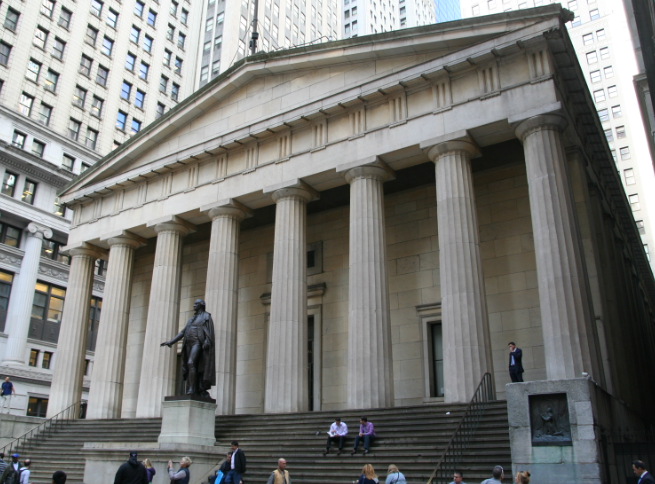
Amidst the skyscrapers of Lower Manhattan, Wall Street is not only synonymous with the financial district but also preserves an outdoor landmark closely linked to early American history. A bronze statue of George Washington stands on the steps of the Federal Hall National Memorial at 26 Wall Street. Facing Wall Street, it forms a highly recognizable urban outdoor landscape with the surrounding dense office buildings, stone structures, and the New York Stock Exchange.
1. Where is the George Washington statue on Wall Street?
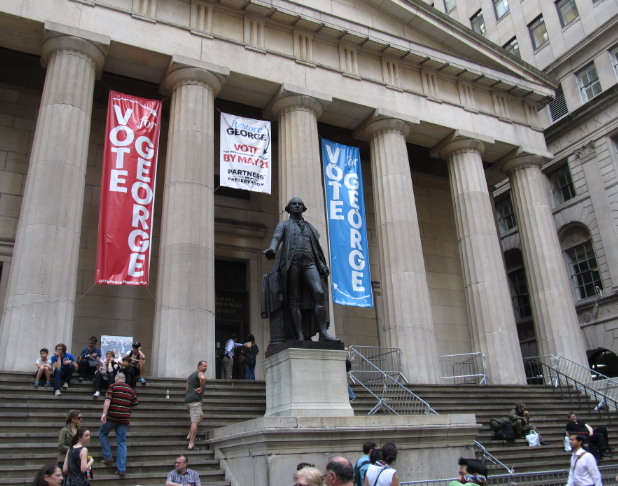
This George Washington Statue is located on the front steps of the Federal Hall National Memorial, specifically at 26 Wall Street, New York City. The statue’s location was not random, as it is the site of Washington’s swearing-in ceremony for his first inauguration as President of the United States in 1789.
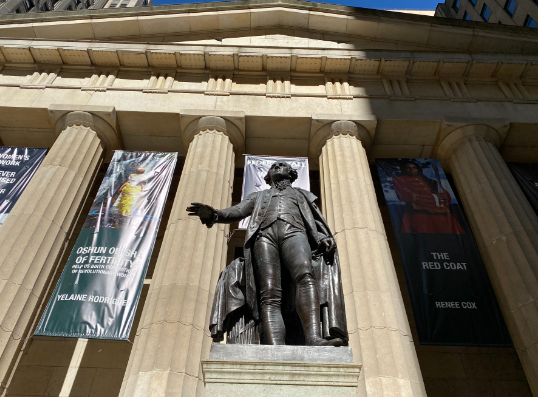
Today, standing on Wall Street, the statue is easily visible in front of the building’s central entrance. The Federal Hall’s massive classical colonnade forms a backdrop, while the statue stands on a high pedestal. Unlike memorial sculptures placed in the center of large parks, this work is directly integrated into the bustling city street, thus serving as both a historical monument and an integral part of Manhattan’s financial district’s outdoor space.
2. Why was the statue placed in this location?
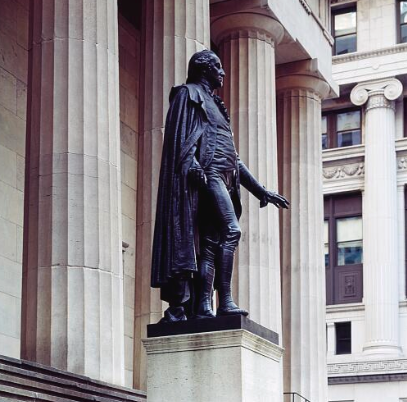
On April 30, 1789, Washington was sworn in as the first President of the United States from the second-floor balcony of the original building here. That building was later demolished, and the Federal Hall we see today is not the original 1789 building, but a customs house opened in 1842, which later served as a branch of the U.S. Treasury.
To commemorate the inauguration ceremony at this location, sculptor John Quincy Adams Ward created this bronze statue of Washington. According to the National Park Service, the statue was installed in 1882 on the steps of the Federal Hall facade, roughly corresponding to the location where Washington was sworn in.
Therefore, this outdoor sculpture has a very direct historical connection with the surrounding buildings: it is not simply placing a historical figure on Wall Street, but commemorating the site of a relevant event.
3. What are the characteristics of the statue’s design?
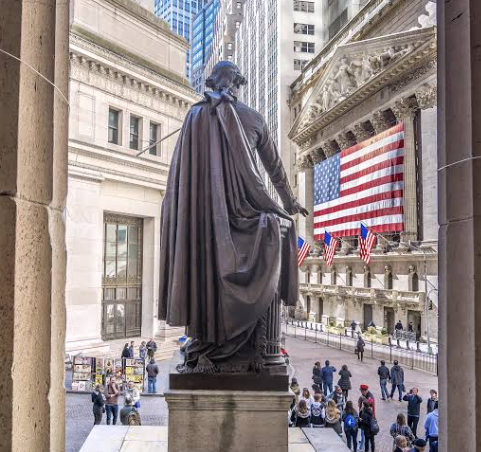
The statue depicts Washington standing, dressed in 18th-century clothing, with a stable and upright posture. Compared to typical equestrian Washington statues, this piece lacks complex elements of warhorses or battlefields, focusing instead on the figure itself.
Viewed from the street, the high pedestal and the wide stone steps of Federal Hall further enhance the figure’s verticality. A row of tall columns behind creates a regular and symmetrical architectural backdrop, allowing the statue to stand out clearly from its surroundings despite being located in densely built-up Manhattan.
This combination of sculpture, steps, and colonnade makes it suitable for observation from different distances: up close, one can appreciate the figure’s clothing and posture; stepping back to the other side of the street reveals the relationship between the statue and the complete facade of Federal Hall.
4. Begin your exploration of Wall Street’s outdoor spaces from the statue
For those who enjoy urban walking and outdoor historical sites, the Washington statue serves as a natural starting point for exploring Manhattan’s financial district. Federal Hall is just steps from the New York Stock Exchange, and also not far from the ferry terminal for the Statue of Liberty and Ellis Island, as well as the 9/11 Memorial.
Even when the interior of Federal Hall is closed, the National Park Service notes that visitors can still enjoy the architecture and the Washington statue from the outdoors. This also distinguishes the George Washington Statue on Wall Street from many historical artworks that require a visit to a museum. It is always situated within the urban landscape: in front of bustling Wall Street, behind the classically styled Federal Hall, and surrounded by the modern skyscrapers of the financial district. The historical sculpture meets the modern urban space directly here, making it one of the most representative outdoor landscapes in downtown New York.